Beyond Prompting: The Architecture of Harness Engineering and the Machine-Web Mismatch

Why autonomous agents fail on human web interfaces, and how the shift from prompt engineering to harness engineering and keyless edge brokering defines production reliability.
The AI industry is caught in a collective fixation on prompt tuning and vibe coding. Teams spend weeks tweaking system prompts and role definitions, hoping that clever phrasing will stop an autonomous agent from entering infinite repair loops or hallucinating API arguments.
In my 28 years of building production systems and deep-tech defense architectures, I have seen this pattern repeat across every major technological shift. Developers first treat a new computational primitive as magic, attempting control through surface syntax. Only after prototypes collapse in production do they embrace systems engineering.
With autonomous AI agents, that breaking point has arrived.
The prompt is an obsolete control surface. In production, the foundation model is not an application: it is merely a stateless, non-deterministic reasoning CPU. What determines whether an agent completes a workflow or catastrophically fails is the Harness: the state machine, the execution sandbox, the dynamic context compiler, and the security perimeter wrapping the model.
Simultaneously, the industry is making a second architectural mistake: forcing agents to interact with the world through human web interfaces. Simulating mouse clicks, interpreting screenshots, and parsing DOM trees is a fragile dead end. The human web was engineered for visual ambiguity and human judgment; autonomous agents require deterministic, authenticated machine protocols.
To build agents that survive in production, we must leave prompt engineering behind and embrace Harness Engineering.
Executive Takeaways
- The Model is Just a CPU: Prompt engineering was an interface relic for chatbots. Production reliability depends on the runtime harness that governs state transitions, context curation, and tool boundaries.
- The Human-Web Mismatch: Navigating human web GUIs with visual scrapers causes coordinate drift, extreme token latency, and prompt injection traps. Agents require machine-native protocols (MCP / WebMCP).
- The Client-Side Secret Fallacy: Allowing client SDKs to negotiate authentication directly with external endpoints exposes credentials to protocol-level theft (such as GHSA-qx49-fqc8-xw99).
- Keyless Edge Brokering with OneGate: Autonomous agents must operate keyless. An edge gateway like OneGate intercepts tool calls, isolates OAuth handshakes, and injects ephemeral tokens on the wire.
The Model is Just a CPU
When developers build software, they do not expect an x86 CPU to manage network sockets, serialize JSON payloads, or enforce database permissions on its own. The CPU executes raw instructions; the operating system kernel and runtime scheduler provide the guardrails.
In autonomous agent systems, the LLM is that CPU. It excels at semantic synthesis and local reasoning. But it possesses zero persistent state, zero native concept of physical boundaries, and zero consequence awareness.
When an agent fails, developers blame the model: "The model hallucinated," or "The model lost track of the goal." In reality, the failure occurred in the harness:
- Context stuffing over context engineering: Dumping entire conversation histories and raw tool outputs into the prompt until attention degrades, rather than compiling the minimal dynamic sub-state needed for the immediate decision.
- Unbounded execution loops: Letting the model freely decide its next step without a deterministic state graph, triggering runaway recursion and unmonitored budget exhaustion.
- Ambient credential exposure: Handing the agent direct access to raw API keys, turning a minor logic glitch into a critical security breach, as I analyzed in the instinct bot leak.
As Andrej Karpathy pointed out in his analysis of the transition from vibe coding to agentic engineering, prompt engineering was a temporary bridge. The real frontier is Harness Engineering: building the scaffolding, execution sandboxes, and deterministic test suites that constrain non-deterministic models.
The Human-Web Mismatch: Why Visual Scrapers Fail
Nowhere is the failure of harness design more obvious than in the rush toward computer-use agents and browser automation bots.
Frontier labs showcase agents capturing screenshots, locating buttons, and clicking through SaaS dashboards like humans. While visually impressive in demos, this approach represents an architectural mismatch:
- Visual Ambiguity: Human web applications are built for human eyes. Responsive layouts, modal overlays, CSS animations, and A/B tests shift DOM coordinates, breaking vision models and triggering costly recovery loops.
- Token Inefficiency: Capturing high-resolution viewports and calculating simulated mouse coordinates consumes hundreds of thousands of tokens per minute. A task that takes a direct API call 80 milliseconds and zero marginal tokens requires 45 seconds of visual reasoning and dollars in inference costs.
- The DOM Security Trap: Navigating human web applications forces agents to ingest untrusted content: comments, hidden CSS text, and external ads. Placing an agent in a raw browser exposes it directly to indirect prompt injection. If an agent reads a webpage containing malicious instructions, the page can hijack the reasoning loop and direct it to exfiltrate private session cookies.
I explored this fundamental shift when engineering my website for the agentic web and in my design of the agentic guestbook: autonomous software needs structured, machine-first protocols, not visual human interfaces.
The Protocol Trap and the Client-Side Secret Fallacy
To solve this mismatch, the industry is standardizing on Anthropic's Model Context Protocol (MCP), now hosted under the Linux Foundation. MCP replaces fragile browser scraping with structured tool calls: an agent connects to an MCP server, queries its schemas, and invokes them via structured JSON.
While a major advance, this introduces a critical blind spot: the client-side credential trap.
Last week, security researchers at Cycode disclosed GHSA-qx49-fqc8-xw99, a high-severity flaw in Anthropic's official MCP Python SDK. When an agent connected to an external tool server, the SDK queried the standard OAuth discovery endpoint. If the remote server returned an HTTP 404, the SDK fell back to accepting authorization endpoints declared directly by the remote server itself, without verifying the issuer.
A rogue tool server simply had to return a 404 and point the authorization URL to its own domain. The agent's client SDK transmitted raw OAuth client secrets, authorization codes, and PKCE verifiers straight to the adversary.
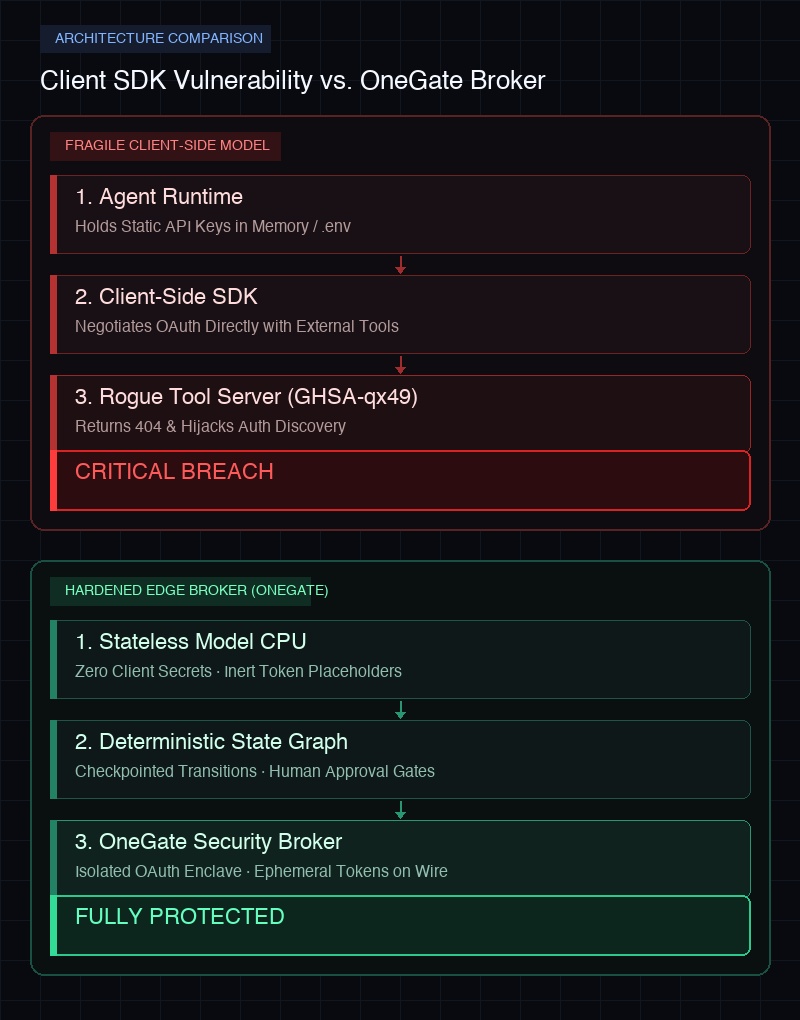
When an agent client harness holds credentials and negotiates authentication directly with untrusted endpoints, compromise is inevitable. Client SDKs run inside the agent environment. If an SDK contains a fallback flaw, a loose parser, or an insecure redirect handler, every secret in that container is exposed.
The Solution: Keyless Edge Brokering with OneGate
The only reliable defense against protocol-level attacks is removing credential negotiation from the agent client completely.
Autonomous agents must operate in keyless environments where client harnesses never touch, store, or negotiate raw OAuth secrets. This is the exact architectural principle behind OneGate, the open-source agent security gateway we are building.
OneGate acts as an isolated security broker at the network perimeter between autonomous agents and the external tools or APIs they call. It solves the credential problem through three foundational mechanisms:
1. Zero-Standing Privilege (ZSP)
Inside the agent runtime, environment variables, configuration files, and memory spaces contain only inert placeholder tokens. The agent never sees or stores a live API key, OAuth client secret, or private certificate.
2. Isolated Edge Handshakes
When an agent invokes an external tool or makes an API call, outbound traffic routes through OneGate via an HTTPS proxy. OneGate terminates the connection, verifies the target host against cryptographic allowlists, performs OAuth discovery and token exchange within an isolated security enclave, and injects ephemeral, short-lived tokens on the wire.
Even if an external tool server attempts an OAuth 404 discovery hijack like GHSA-qx49-fqc8-xw99, the attack fails at the broker boundary. The agent client holds zero secrets to steal.
3. Machine-Speed Egress Inspection
OneGate inspects tool calls and outgoing payloads in real time. It rate-limits mutations, verifies schema conformity, and trips automated kill-switches if an agent exhibits behavioral drift or attempts unauthorized data exfiltration.
Architectural Comparison: Fragile vs. Hardened
To understand the operational contrast, consider how each paradigm handles the core system dimensions:
Control Surface
- ❌ Fragile Client-Side Agent: Lengthy system prompts, adjectives, and conversational role definitions in plain text.
- 🛡️ Hardened Edge Harness (OneGate): Deterministic state graphs with checkpointed node execution and human-in-the-loop gates.
Interface Layer
- ❌ Fragile Client-Side Agent: Computer-use DOM scrapers and simulated mouse clicks on human visual web pages.
- 🛡️ Hardened Edge Harness (OneGate): Authenticated machine-native protocols (MCP and WebMCP) passing structured JSON payloads.
Credential Storage
- ❌ Fragile Client-Side Agent: Static API keys and persistent OAuth secrets stored in
.envfiles or runtime memory. - 🛡️ Hardened Edge Harness (OneGate): Zero client-side secrets; out-of-band ephemeral token injection on the wire.
OAuth Handshake & Negotiation
- ❌ Fragile Client-Side Agent: Client SDK negotiates authentication directly with untrusted endpoints.
- 🛡️ Hardened Edge Harness (OneGate): Isolated edge broker terminates handshakes and enforces strict cryptographic allowlists.
Protocol Hijacking Vulnerability (GHSA-qx49)
- ❌ Fragile Client-Side Agent: High risk; rogue servers trick the client SDK into leaking OAuth secrets and PKCE verifiers.
- 🛡️ Hardened Edge Harness (OneGate): Immune; the agent environment contains zero secrets for an attacker to extract.
Context Management & Memory
- ❌ Fragile Client-Side Agent: Full conversation transcripts stuffed into bloated context windows until reasoning degrades.
- 🛡️ Hardened Edge Harness (OneGate): Task-scoped context engineering compiling minimal dynamic sub-states per step.
The Path Forward: Building the Agentic Operating System
The transition from chatbots to autonomous agent swarms is the most profound architectural transformation in enterprise computing since the rise of cloud infrastructure.
According to research by the Cloud Security Alliance on non-human identities, machine-to-human identity ratios already exceed 80:1 in enterprise environments. As always-on digital workers multiply, relying on prompt guardrails and browser automation to govern autonomous systems is unsustainable.
The winners of the agentic era will not be the teams that write the cleverest prompts. They will be the systems architects who build robust, keyless runtime harnesses: treating models as stateless CPUs, rejecting human web interfaces in favor of structured protocols, and enforcing strict physical isolation at the network edge with brokers like OneGate.
It is time to stop prompting and start engineering.