The AI-Native Web: Why Autonomous Agents Are Turning the CMS into a Bithost

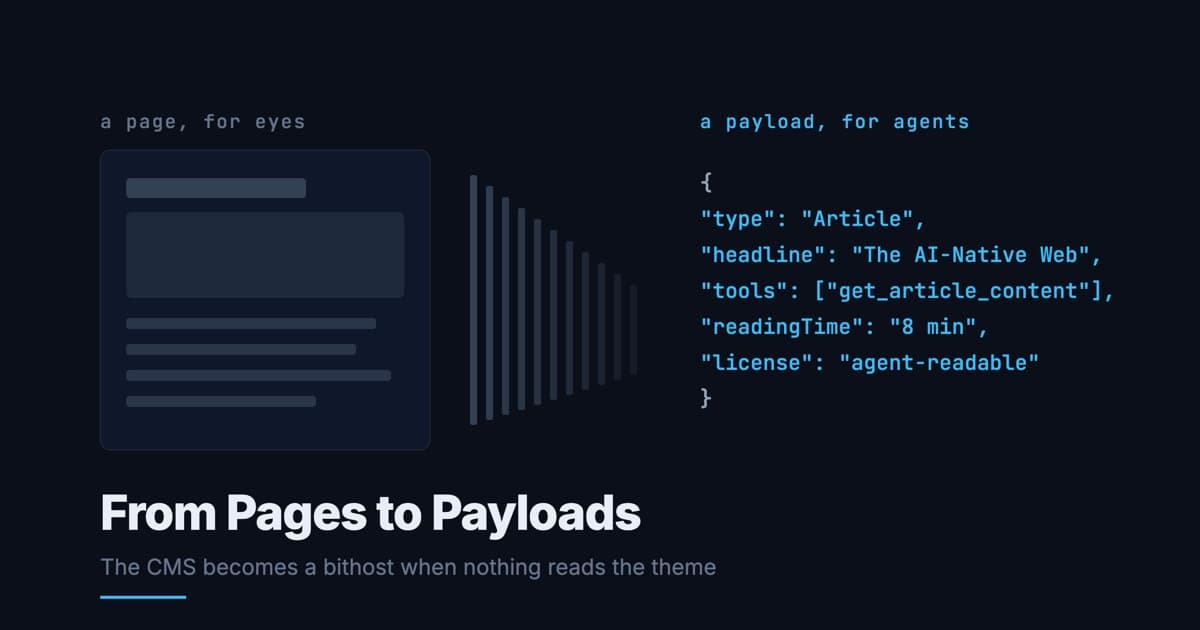
How generative agents, dynamic intent assembly, and machine-first discovery are dissolving the traditional CMS, turning legacy platforms into commodity bithosts.
For three decades, the web operated on an unstated compromise: building and running a website required translating human ideas into structured relational databases, admin forms, and visual template builders.
To bridge that gap, the software industry constructed a multi-billion-dollar empire around Content Management Systems. Platforms like WordPress, Drupal, and later Webflow, Squarespace, and Wix existed for one fundamental reason: non-technical humans needed visual abstractions to create and publish content without touching raw code or deployment pipelines.
That compromise is now obsolete.
When an autonomous AI agent can read a code repository, interpret natural language editorial intent, generate validated TypeScript components, test them, and commit them directly to production in seconds, the traditional CMS stops being an asset. It becomes pure overhead.
The added value of legacy CMS platforms compared to native AI-driven architectures is marginal in the best case. The content management layer is collapsing, and the companies built around it face an existential shift.
The Telco Precedent: The Invention of the Bitpipe
To understand where the web platform layer is heading, we have to revisit what happened to telecommunications companies two decades ago.
In the late 1990s and early 2000s, mobile network operators were convinced that their future lay in content curation. Telecom giants poured billions into proprietary walled gardens: Vodafone Live!, Orange World, Verizon V Cast, and carrier-managed WAP portals. They signed exclusive deals with record labels for ringtones, tried to control mobile news feeds, and attempted to own customer engagement through their own branded portal menus.
Carriers operated under the conviction that the physical network was only a foundation, and that managing the content on top of that network was where long-term margins would live.
Then the modern smartphone arrived.
The moment mobile devices carried full web browsers and open app stores, carrier portals evaporated. Users bypassed operator menus entirely to access the open web and native applications directly.
The carriers did not die, but their ambition to be content platforms died completely. They were forced down the value chain into "bitpipes": utility providers that deliver raw data packets efficiently. All the software intelligence, application logic, and profit margins moved into the application and platform layers above them.
The exact same economic gravitational pull is now acting on Content Management Systems.
The Birth of the Bithost
For years, platforms like WordPress and Webflow justified their valuations by bundling three distinct layers together:
- Storage and Hosting: Serving static assets, databases, and edge distribution.
- Visual Builder / Admin UI: Drag-and-drop canvases, WYSIWYG editors, and content entry forms.
- Information Architecture: Deciding how content links together, how schemas are validated, and how layouts respond across viewports.
Layer 2 and Layer 3 were where these platforms captured almost all of their software margins. Hosting was relatively cheap; the recurring subscription fee was for the abstraction that let a human avoid code.
Native AI development destroys that abstraction.
When an engineer or content creator uses an agentic toolchain, they do not need an admin panel with dozens of form fields. They draft in markdown or speak in plain language. The agent structures the data, validates the TypeScript types, builds responsive components, updates sitemaps, verifies accessibility, and runs end-to-end integration tests.
What remains of the legacy CMS when authoring and page-building tasks are executed natively by AI?
Only the hosting and the domain routing.
Just as mobile carriers were forced to become bitpipes, traditional CMS providers are being forced to become "bithosts." They will host static assets and serve traffic at the edge, but their proprietary visual canvases and administrative dashboards will become redundant legacy clutter.
The Five Structural Shifts of the AI-Native Web
This transformation will not happen in a single leap. It is unfolding through five distinct phases, roughly in order of how soon they are landing:
1. Generation Becomes the Default, Not a Feature
Today, AI writing and image tools sit as bolt-on features on top of legacy CMS platforms: Wix ADI, Webflow AI, and WordPress AI blocks. Within a couple of years, generating a full page or section from a prompt will be the primary authoring flow, with manual editing becoming the fallback rather than the norm.
2. The "Page" as a Unit Dissolves
Traditional CMS thinking is built around static pages and rigid templates. As more content gets assembled dynamically per visitor (personalized copy, contextual layouts, and adaptive structure), the CMS job shifts from "store and render pages" to "store structured content and intent, letting an AI layer assemble the experience at request time." Headless CMS platforms like Contentful and Sanity are relatively better positioned here because they already separate content schemas from presentation.
3. Natural Language Becomes the Primary Interface
Instead of clicking through visual canvases, nested menus, and form fields, creators will simply instruct the system in natural language: "Make the hero section punchier and swap the testimonial for our most recent enterprise case study." The agent edits the code and assets directly. This favors platforms with clean, structured data models, because an AI agent needs unambiguous fields to act on reliably.
4. SEO and Discovery Logic Changes Shape
A massive portion of legacy CMS value today is wrapped up in human-facing SEO tooling. When discovery and web traffic shift toward AI answer engines, agentic search, and autonomous delegates, websites must optimize for machine readability, citations, and semantic execution just as much as traditional search rankings. Platforms must natively support protocols like WebMCP, OpenAPI 3.1, and rich structured JSON-LD schemas.
5. Severe Consolidation Risk for Mid-Tier Players
The CMS platforms most exposed are those whose main value proposition was "easy drag-and-drop for non-technical users" (Wix, Squarespace). That advantage collapses once an AI agent can build bespoke, production-grade frontend code directly from an intent prompt. Headless, API-first architectures and enterprise systems with rigorous governance, auditing, and compliance are more insulated, because autonomous generation still requires typed schemas and audited APIs to write to.
Human-Directed, AI-Owned Architecture
A common misunderstanding about this shift is that AI will simply flood the web with autonomous, uncurated copy. That is the wrong mental model.
The real architecture is human-directed and AI-executed:
- Humans own intent and strategy: Original ideas, personal voice, technical conviction, editorial taste, and strategic direction come from people.
- AI owns structure and execution: Converting raw thoughts into validated schemas, updating navigation graphs, compiling static pages, optimizing asset delivery, and publishing machine-readable WebMCP endpoints are handled by AI agents.
This setup offers the best of both worlds. A founder or writer works in clean text files or speaks their core argument. An agent formats the piece, builds the necessary components, updates the RSS feed, verifies SEO tags, checks accessibility, and opens a pull request.
There is no database to migrate, no plugin update that breaks production, no vendor lock-in, and no monthly subscription to a proprietary dashboard. The entire site remains plain code and plain text, version-controlled in Git.
SaaS Is Not Dead, It Is Changing Format
It has become fashionable in tech circles to claim that "SaaS is dead."
SaaS is not dead, but its format is undergoing a structural phase shift. Software products whose primary value proposition was serving as a graphical user interface on top of a database table are in severe trouble. A CMS is the textbook example of this category: an expensive UI sitting between a human and a database.
When the user interface for creation shifts from manual form-filling to conversational and autonomous agents, the middleman software layer evaporates.
The companies that survive will not be the ones that paste a basic "AI writing assistant" button inside their legacy rich-text editors. Tacking an LLM prompt into an existing visual builder does not solve the fundamental problem that the visual builder itself is no longer needed.
To stay relevant, web platforms must provide high-performance agent-first primitives: instant edge rollouts, cryptographic content verification, deterministic machine discovery, and specialized edge infrastructure that autonomous systems can program directly.
The Honest Uncertainty
The open question is not whether the CMS must change, but what shape the winning architecture will take:
Will this evolution end with a small handful of hyper-concentrated CMS platforms doing end-to-end AI generation from prompt to edge deployment, or will it result in a radically thinner infrastructure layer (pure structured storage and edge CDNs) with autonomous AI agents orchestrating everything on top?
These are informed architectural projections rather than settled outcomes. But one reality is already certain: when technology makes your walled garden irrelevant, you either become a commodity utility, or you disappear.