The Agentic Web: Why Machine-Native Networks Will Dwarf the WWW

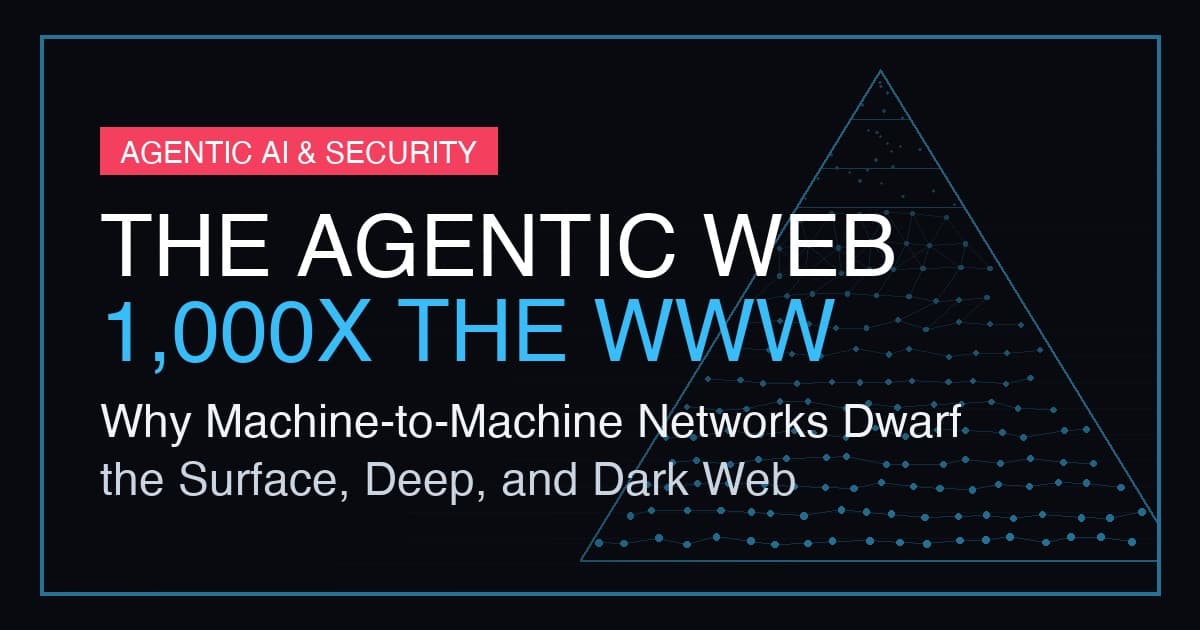
The Surface Web, Deep Web, and Dark Web were all constrained by a single biological bottleneck: human eyeballs and manual clicks. Removing that bottleneck will make the Agentic Web thousands of times larger than the WWW.
- The Biological Ceiling of the Legacy Web: For thirty-five years, the Surface Web (WWW), the Deep Web, and the Dark Web shared a single structural ceiling: a human had to sit at the end of the pipe to read, decide, and click. Total web scale was bounded by 8 billion biological brains reading at 200 words per minute.
- The 1,000x Combinatorial Explosion: The Agentic Web removes the human attention bottleneck. When billions of autonomous software agents negotiate, query, verify, and transact with each other 24/7 at wire speed, network surface area scales with compute and token throughput rather than human waking hours.
- From Pixels to Protocols and Keyless Trust: The Agentic Web replaces visual HTML/CSS rendering with machine-native discovery and execution layers (
/llms.txt,/.well-known/ard.json, WebMCP, and OpenAPI), secured at the perimeter by keyless cryptographic brokers like OneGate.
For the past three decades, computer scientists and security researchers have used a classic iceberg metaphor to explain the topology of the internet.
At the top sits the Surface Web (the World Wide Web): the hundreds of billions of HTML pages that Google, Bing, and the other public engines have crawled and indexed. Beneath the waterline sits the Deep Web: the authenticated databases, corporate intranets, medical portals, financial ledgers, and dynamic SaaS dashboards that require a login session or specific query parameters to access. At the very bottom sits the Dark Web: the encrypted overlay networks (Tor onion services, I2P) built for anonymity and hidden routing.
Generations of engineers were taught that the Deep Web is roughly 400 to 500 times larger than the Surface Web, and that this three-tier iceberg represents the complete universe of networked information.
It is worth knowing where that number came from. It traces to a single white paper Michael Bergman published in 2001, written at a company that sold deep web search, on data crawled in March 2000. It has been quoted for twenty-five years without being remeasured. It describes a web that predates the smartphone, the cloud, and the API economy.
That mental model is now obsolete.
Across a career spent building software systems, architecting high-throughput fraud engines at nSure.ai, founding Clarity to defend against synthetic deception, and engineering OneGate, I have watched the internet evolve from static documents to interactive applications. Today, we are crossing a far more radical threshold: the birth of the Agentic Web.
The Agentic Web is a new network stratum that will become THE Web, growing thousands of times larger than the WWW, the Deep Web, and the Dark Web combined.
1. How Do the Four Web Layers Compare in Architecture and Scale?
The Surface Web, Deep Web, and Dark Web are human-terminated networks where servers render pixels for biological eyes. The Agentic Web is a machine-terminated network where autonomous agents discover capabilities, negotiate schemas, and execute cryptographic transactions directly with remote systems at wire speed.
To understand why the Agentic Web will eclipse every prior layer of the internet, we have to examine the hidden constraint that governed the first three epochs of the web.
The legacy web is the cap. The Agentic Web is the base.
Drawn schematically. The legacy cap is about one twelfth of this pyramid by area. Section 2 derives the real ratio, which is nearer a thousand to one and does not fit on a page.
- Consumer:
- human eyes reading rendered HTML and CSS
- Discovery:
- search crawlers, hyperlinks, SEO
- Bottleneck:
- biological attention
- Consumer:
- authenticated human sessions in ERP and CRM dashboards
- Discovery:
- login walls, session cookies, private intranets
- Bottleneck:
- manual clicks, form fills, seat-based workflows
- Consumer:
- anonymized human operators and marketplace forums
- Discovery:
- onion routing, unlisted directory hashes
- Bottleneck:
- high-latency relays and manual human escrow
- Consumer:
- autonomous agents running at wire speed, around the clock
- Discovery:
- WebMCP,
/.well-known/ard.json,/llms.txt, OpenAPI - Bottleneck:
- compute and token throughput, not human hours
Every legacy web layer was architected around a single biological assumption: a human being is the final consumer of the session.
- The Surface Web (WWW): Built on HTTP, HTML, and CSS. A web server fetches rows from a database, formats them into visual typography and layout grids, and ships kilobytes of styling code to a browser so a human eye can scan the page. If a page cannot capture human attention, it has no economic reason to exist.
- The Deep Web: Built on session cookies, OAuth logins, and role-based UI dashboards. Although the underlying databases hold petabytes of records, the interface layer is still throttled by human operators clicking filters, exporting CSVs, and reviewing rows inside enterprise SaaS portals.
- The Dark Web: Built on onion routing and hidden services. Despite its cryptographic transport layer, it remains a collection of human-operated forums, marketplaces, and messaging boards constrained by manual human trust and high-latency relays.
In all three layers, the economic and structural size of the network was hard-capped by human attention bandwidth. There are 8 billion people on Earth, each with at most 16 waking hours a day, reading at roughly 200 words per minute and clicking one button every few seconds.
That ceiling shows up in two places that have nothing to do with security, which is why they belong here rather than alongside the cryptography later on.
/.well-known/ard.json, /llms.txt, WebMCP, OpenAPI 3.1) consumed directly as strongly typed tool schemas.
2. Why Will the Agentic Web Be Thousands of Times Bigger Than the WWW?
The Agentic Web scales with silicon compute and sub-millisecond API synthesis rather than human biology. Each human user and enterprise spawns dozens of specialized background agents that continuously query, negotiate, verify, and transact across thousands of machine endpoints per minute.
When you remove the biological eyeball from the loop, three mathematical multipliers compound simultaneously.
Human-Terminated WWW vs. Machine-Native Agentic Web
Human-Terminated Web (WWW / Deep Web)
- 1:1 Biological ConcurrencyOne human operator navigates one browser tab at a time
- Pixel & DOM OverheadServers render heavy HTML, CSS, and JavaScript bundles for visual layout
- Coarse-Grained DestinationsMonolithic web pages designed for broad human readability
Hard ceiling: bounded by human waking hours and click speed
The Agentic Web (Machine-to-Machine)
- 1:1,000+ Agent Fan-OutOne human intent spawns hundreds of parallel agent-to-agent sub-tasks
- Structured Protocol ExecutionDirect schema exchange via WebMCP, OpenAPI, and typed function calls
- Ephemeral Micro-EndpointsBillions of specialized data, verification, and compute nodes
Unbounded scale: 1,000x to 10,000x larger network graph
Multiplier A: The 1-to-1,000 Fan-Out Ratio
On the World Wide Web, if you want to plan a supply-chain shipment or audit a software dependency tree, you open a browser and visit five or ten websites. Your patience runs out after the tenth tab.
On the Agentic Web, a single high-level human instruction triggers an orchestration tree. Your primary agent delegates sub-tasks to twenty specialized procurement, compliance, pricing, and security agents. Each of those agents queries fifty remote supplier, logistics, weather, and risk-scoring endpoints in parallel. A single human intent that previously generated 5 page views on the WWW now generates 1,000 structured machine-to-machine transactions across the Agentic Web.
Multiplier B: The Death of the Page and the Rise of Micro-Capabilities
Why does the WWW only have 50 billion indexed pages? Because building, designing, and maintaining a human-facing website is expensive. You need frontend engineers, UX designers, copywriters, responsive layout grids, and localization teams. A capability only gets published to the WWW if the expected human traffic justifies the UI development cost.
In the Agentic Web, nobody needs a UI.
Every internal script, database view, actuarial pricing model, sensor feed, compliance verifier, and specialized domain classifier can be exposed directly as a machine-callable capability via WebMCP, built on the Model Context Protocol, alongside /.well-known/ard.json and /llms.txt. Zero CSS. Zero React components. Zero marketing copy. When the cost of publishing a network node drops from a six-week frontend project to a twenty-line JSON schema, the number of addressable nodes on the internet explodes by three orders of magnitude.
Multiplier C: Continuous 24/7 Autonomous Loops
Humans sleep eight hours a day and spend most of their working hours in meetings. Autonomous agents do not sleep. Background monitoring agents, continuous codebase refactoring swarms, treasury optimization agents, and threat-hunting agents operate 24 hours a day, 365 days a year, negotiating state changes across millions of endpoints every second.
Doing the Arithmetic
A headline multiple is worthless until you say what it counts, so here is the derivation rather than the slogan.
The three multipliers do not measure the same thing. Multiplier B is a count of addressable endpoints, the network's surface area. Multipliers A and C are rates: transactions per human intent, and hours of the day spent transacting. They answer different questions and they do not belong in the same product.
Counted as surface area, the collapse in publishing cost is the whole argument. A capability that needed a six-week frontend project to reach the web now needs a JSON schema and an afternoon. That is the three orders of magnitude in Multiplier B, and it lands at roughly 1,000x the node count of the WWW. This is the figure quoted in the title, and it is the conservative one.
Counted as interaction volume, the number is far larger and far less defensible. Multiplier A turns five page views into a thousand structured calls, call it 200x. Multiplier C roughly triples the duty cycle against a human working day. Apply both across a node population that is already a thousand times denser and the traffic figure runs into the hundreds of thousands, which is a number I do not think anyone can honestly defend yet.
So the claim in this essay is the smaller one, and it is a claim about how many things are reachable, not how often they are called. If only Multiplier B holds and the other two are pure hype, the Agentic Web is still a thousand times the network the WWW ever was.
3. Why Scraping the WWW Is a Dead End for Autonomous Agents
Running headless browsers to scrape human HTML pages is a brittle transitional hack. The true Agentic Web operates on deterministic capability discovery, structured schemas, and machine etiquette rather than pixel emulation.
Right now, much of the industry is trying to force autonomous agents onto the legacy Surface Web by spinning up headless Chromium instances, taking screenshots of DOM trees, and guessing which CSS selector corresponds to a "Submit" button.
As I analyzed in Beyond Prompting: The Architecture of Harness Engineering and the Machine-Web Mismatch, forcing an AI agent to navigate a human web page is like forcing a self-driving car to operate a mechanical robot with rubber fingers on a steering wheel instead of wiring its computer directly to the drive-by-wire bus.
- Token Bloat and Semantic Noise: A typical e-commerce or SaaS page ships 2 megabytes of nested
<div>tags, tracking pixels, and ad scripts to convey 300 bytes of actual product state. - Adversarial WAF Collision: Web Application Firewalls (Cloudflare, Akamai, DataDome) were built to block non-human traffic on the WWW. When legitimate agents pretend to be humans via headless browsers, they look identical to automated fraud swarms.
- Indirect Prompt Injection: Unstructured HTML comments and hidden DOM nodes are the primary delivery mechanism for indirect prompt injection, which sits at number one on the OWASP Top 10 for LLM applications. Every scraped web page is an untrusted code execution hazard.
When I built the Agentic Guestbook on this site, I designed it as a working prototype of the Agentic Web. Instead of forcing visiting agents to parse React components, the domain announces its machine-native contract in the HTTP response headers (Link: </.well-known/ard.json>; rel="agentic-resource-discovery"), serves clean Markdown corpora via /llms.txt, and exposes strongly typed JSON-RPC and HTTP tool endpoints with zero UI friction.
4. What Is the Security Foundation of the Agentic Web?
Because the Agentic Web operates at machine speed without human visual inspection, ambient session cookies and static API keys are fatal liabilities. The Agentic Web requires end-to-end cryptographic identity and keyless perimeter brokering.
On the World Wide Web, a human user acts as a biological circuit breaker. If a phishing site looks suspicious or a checkout page asks for an absurd wire transfer, a human can pause and close the tab.
On the Agentic Web, transactions execute in milliseconds across chains of delegated sub-agents. If an agent holds raw API keys, session cookies, or database credentials in its runtime environment, a single poisoned response from a remote node can exfiltrate every secret the agent owns.
.env API keys, and probabilistic behavioral bot scores that fail when agents mimic human kinematics.
To survive in a web that is thousands of times larger and faster than the WWW, enterprise architectures must enforce three foundational rules:
- Publish Dual-Horizon Surfaces: Every service you build must expose a clean, deterministic machine contract (
/.well-known/ard.json,/llms.txt, and typed MCP/HTTP endpoints) alongside its human UI. If an autonomous agent has to scrape your DOM to do business with you, your architecture is stuck in 2015. - Eliminate Ambient Credentials from Agent Runtimes: Never inject raw API keys, OAuth tokens, or database credentials into an agent's environment or MCP config. Route all outbound agent traffic through a keyless perimeter broker like OneGate that validates policy and injects credentials strictly on the wire.
- Anchor Delegation in Cryptography: As I wrote in Authentication Is Dead? Nonsense., behavioral heuristics cannot distinguish an authorized agent from a hijacked one. Every cross-domain transaction on the Agentic Web must carry a hardware-backed cryptographic proof of origin and a scoped delegation mandate.
The World Wide Web connected human eyes to static documents. The Deep Web connected human employees to private databases. The Agentic Web connects all of human and machine intelligence into a continuous, self-executing economic fabric.
Within five years, we will stop calling it the Agentic Web. We will simply call it the Web, and the human-rendered pages of the old WWW will look like a tiny, decorative storefront sitting on top of a planetary machine economy.