From N-Grams to Transformers: What Building NLU in 2010 Taught Me About Modern LLMs

A deep technical reflection from my time as CTO of Ginger Software (2010–2014) on how natural language processing evolved from brittle statistical pipelines to modern reasoning engines.
Between 2010 and 2014, I served as the CTO of Ginger Software. We were building one of the earliest full-scale natural language correction and rephrasing engines on the consumer web.
At the time, our mission was considered state of the art: understanding what a human intended to write, identifying syntactic and semantic errors in context, and proposing intelligent alternatives.
Looking at today’s large language models, the distance we have traveled in fifteen years is breathtaking. But to truly appreciate what modern LLMs represent, you have to understand the architectural grind of the early 2010s. The transition from classical statistical natural language understanding (NLU) to modern generative foundation models is not merely an upgrade in scale. It is a complete inversion of how machines represent human thought.
The 2010–2014 Stack: Statistical Pipelines and the N-Gram Ceiling
In 2012, processing natural language meant managing a fragile pipeline of discrete, decoupled statistical stages. A standard production architecture looked like this:
- Tokenization and Normalization: Splitting text into words, handling punctuation, and lowercasing.
- Part-of-Speech (POS) Tagging: Running Hidden Markov Models (HMMs) or Conditional Random Fields (CRFs) to tag whether "run" was a noun or a verb.
- Syntactic Parsing: Using Probabilistic Context-Free Grammars (PCFGs) or transition-based dependency parsers to construct hierarchical sentence trees.
- Statistical Language Modeling: Calculating sentence probability using n-gram frequency tables (typically trigrams or 5-grams) with Kneser-Ney or Good-Turing smoothing.
- Noisy Channel and Edit Distance Models: Scoring candidate word corrections based on keyboard adjacency, phonetic confusion matrices, and Levenshtein distance.
- Rule-Based Heuristic Layers: Thousands of handcrafted regex rules and exception dictionaries to catch edge cases the statistical models botched.
The Sparsity Curse and One-Hot Orthogonality
The foundational flaw of that era was how words were represented: as discrete, independent symbols.
In classical NLP, every word was a one-hot vector in a vocabulary dictionary. If your vocabulary had 500,000 words, "cat" was a vector with a 1 at index 4,210 and zeros everywhere else. "Feline" was a 1 at index 89,401. Mathematically, their dot product was zero. They were completely orthogonal. The model had zero inherent geometric understanding that a cat, a kitten, and a feline shared biological or behavioral reality.
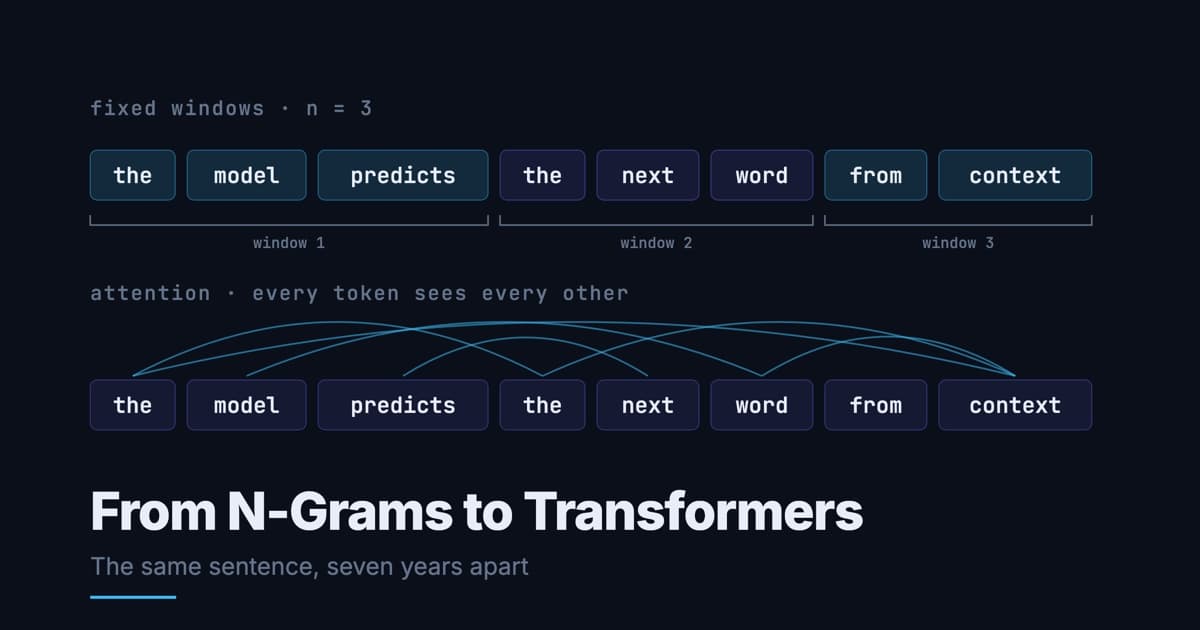
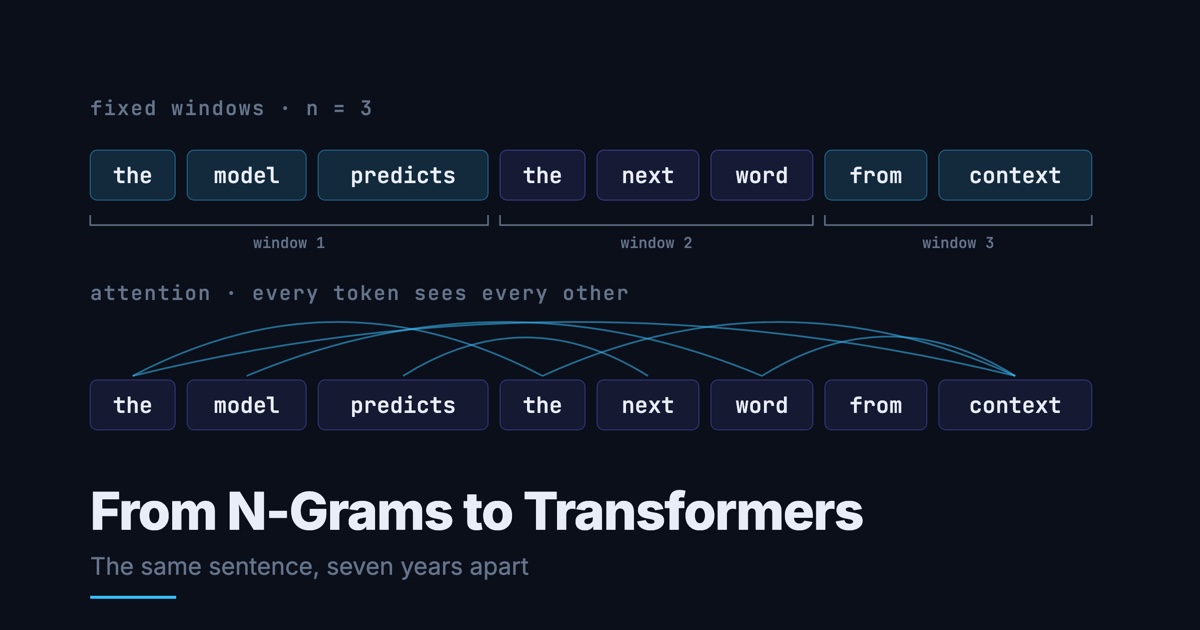
To capture context, we relied on n-grams: counting how often sequences of three, four, or five words appeared across massive web scrapes.
The engineering reality was brutal. Storing and querying billions of 5-gram probabilities in real time required highly optimized, memory-mapped trie structures and distributed key-value stores. Even with terabytes of RAM, the moment a user typed a six-word phrase that had never appeared verbatim in the training corpus, the model hit a wall. Back-off algorithms smoothed the probabilities, but the semantic thread was lost. Context was strictly bounded to a tiny window of three to five adjacent tokens.
Cascading Error Propagation
The pipeline approach had a fatal vulnerability: cascading errors.
If the POS tagger misidentified a word in step 2, the dependency parser built an invalid tree in step 3. The invalid tree fed broken grammatical features into the scoring model in step 4. By the time the system proposed a correction, it was solving for a sentence structure that did not exist. Teams spent thousands of engineering hours tuning manual weights and regex patches to stop one stage from poisoning the next.
The Five Transformational Leaps Since 2014
The breakthrough that brought us to modern LLMs was not a single event. It was a sequence of five structural breakthroughs that dismantled the old pipeline entirely.
+-------------------------------------------------------------------------------+
|                      THE 15-YEAR EVOLUTION OF NLU                             |
+-------------------------------------------------------------------------------+
|                                                                               |
|  2010 - 2014: Statistical Pipelines                                          |
|  [One-Hot Words] -> [HMM POS Tagging] -> [N-Grams] -> [Handcrafted Rules]     |
|  - Strictly local context (3-5 words)                                         |
|  - Zero semantic geometry                                                     |
|  - Cascading pipeline failures                                                |
|                                                                               |
|                                   |                                           |
|                                   v                                           |
|  2013 - 2014: Dense Vector Geometry                                           |
|  [Word2Vec / GloVe]                                                           |
|  - Semantic proximity via cosine distance (king - man + woman = queen)        |
|  - Static embeddings: "bank" had one fixed vector regardless of context       |
|                                                                               |
|                                   |                                           |
|                                   v                                           |
|  2014 - 2017: Sequential Neural Networks                                      |
|  [RNNs / LSTMs / Seq2Seq + Attention]                                         |
|  - Variable-length context                                                    |
|  - Sequential computation bottleneck (cannot parallelize across GPUs)        |
|                                                                               |
|                                   |                                           |
|                                   v                                           |
|  2017: The Attention Revolution                                               |
|  [Transformers / Self-Attention]                                              |
|  - Full GPU parallelization                                                   |
|  - Dynamic contextual embeddings: every token attends to all tokens           |
|                                                                               |
|                                   |                                           |
|                                   v                                           |
|  2018 - 2020: Self-Supervised Foundation Models                               |
|  [BERT (Masked LM) / GPT (Autoregressive Causal LM)]                          |
|  - Pre-training on internet scale                                             |
|  - Next-token prediction builds an implicit world model                       |
|                                                                               |
|                                   |                                           |
|                                   v                                           |
|  2020 - Present: Scale, Emergence & Autonomous Agents                         |
|  [Modern LLMs / Reasoning Models / Tool Execution]                            |
|  - Monolithic end-to-end architecture replaces the pipeline                   |
|  - Emergent in-context learning and multi-step reasoning                      |
|  - Agentic execution: reading repos, calling APIs, self-correcting            |
|                                                                               |
+-------------------------------------------------------------------------------+
1. Dense Semantic Geometry (Word2Vec and GloVe, 2013–2014)
The first crack in the old paradigm arrived around 2013 with Tomas Mikolov's work on Word2Vec. Instead of sparse one-hot vectors, words were projected into continuous, dense vector spaces (typically 300 dimensions).
For the first time, semantic similarity was represented geometrically: words appearing in similar contexts clustered together. Mathematical vector arithmetic worked: the vector for "king" minus "man" plus "woman" landed near "queen."
However, Word2Vec had a major limitation: each word had a single, static representation. The word "bank" in "river bank" and "investment bank" had the exact same vector. Polysemy and dynamic context remained unsolved.
2. The Recurrence Dead-End (RNNs and LSTMs, 2014–2017)
To handle sequence order and variable context, the field turned to Recurrent Neural Networks (RNNs) and Long Short-Term Memory networks (LSTMs).
LSTMs allowed information to persist across sequential steps. But they suffered from two severe bottlenecks:
- Memory Degradation: Over sequences longer than 50 or 100 tokens, the hidden state compressed information until earlier context was forgotten.
- Sequential Execution: An RNN must process token $t$ before it can start token $t+1$. This made it impossible to parallelize training efficiently across large GPU clusters, capping model scale.
3. The Self-Attention Revolution (The Transformer, 2017)
The pivotal moment in modern computing occurred in 2017 with the publication of "Attention Is All You Need" by Vaswani et al.
The Transformer eliminated recurrence entirely. By relying on self-attention mechanisms:
- Every token attends to every other token simultaneously: The representation of the word "bank" is computed dynamically based on every other word in the surrounding sentence.
- Massive Parallelization: Because the entire sequence is processed in a single forward pass, training could scale across thousands of GPUs without sequential waiting.
4. Self-Supervised Pre-Training at Internet Scale (2018–2020)
Before 2018, training NLP models required expensive labeled datasets: human annotators labeling parts of speech, named entities, or sentiment.
The arrival of models like BERT (bidirectional masked language modeling) and GPT (autoregressive next-token prediction) transformed raw text into its own supervision signal. By forcing a model to predict the next word across trillions of tokens of web text, books, code, and papers, the network was forced to internalize:
- Grammar and syntax.
- Factual world knowledge.
- Logic, causal relationships, and common-sense physics.
Next-token prediction turned out to be an engine for world modeling. To predict the next word in an unfinished Python script, medical diagnosis, or legal brief, the model had to learn the underlying rules of Python, medicine, and law.
5. Scaling Laws, Emergence, and In-Context Reasoning (2020–Present)
As parameter counts grew from hundreds of millions to hundreds of billions, language models demonstrated emergent capabilities that were never explicitly programmed:
- Zero-Shot and Few-Shot Learning: The ability to perform a completely new task simply by reading instructions in the prompt.
- Chain-of-Thought Reasoning: Breaking complex multi-step problems into intermediate logical deductions.
- Tool Calling and Agentic Action: Emitting structured parameters to execute shell commands, query databases, browse the web, and interact with APIs.
Comparing Paradigms: 2012 vs. Today
| Architectural Dimension | Classical NLU (Ginger Era: 2010–2014) | Modern LLM NLU (2026) |
|---|---|---|
| Basic Representation | Discrete one-hot symbols in sparse dictionaries | Dense continuous vector spaces with dynamic contextual attention |
| System Architecture | Multi-stage pipeline (Tokenizer $\rightarrow$ POS $\rightarrow$ Parser $\rightarrow$ Scorer) | Monolithic, end-to-end foundation model |
| Context Horizon | Local n-gram window (3 to 5 words) | Millions of tokens with near-perfect retrieval |
| Failure Mode | Cascading errors across pipeline stages | Hallucination and alignment drift |
| Domain Adaptation | Manual dictionary authoring and handcrafted regex rules | In-context prompting, fine-tuning, and retrieval-augmented generation (RAG) |
| Execution Capability | Text analysis and passive string substitution | Autonomous agency: tool execution, code writing, and multi-step workflows |
| Knowledge Storage | Hardcoded relational databases and trie count tables | Distributed parametric weights across billions of attention heads |
The Impact: From Grammar Checkers to Autonomous Reasoning
In 2012 at Ginger, our ultimate ambition was to serve as an intelligent writing co-pilot: catch a spelling mistake, fix a misplaced preposition, or suggest a cleaner rephrase of a clunky sentence.
Today, natural language understanding is no longer about checking grammar. Language has become the universal runtime interface for computing.
Instead of writing custom code to integrate five different APIs, you give an autonomous agent an objective. The agent uses its internal NLU to read API documentation, parse unstructured payloads, reason through edge cases, write integration tests, and handle errors dynamically.
This shift changes software development entirely:
- The Death of Brittle Handcrafted Heuristics: In 2012, 80% of our engineering time went into writing and testing edge-case rules. Modern foundation models eliminate the need for rule writing; they absorb nuance directly from semantic context.
- From Passive Analysis to Active Agency: Classical NLP analyzed text and stopped. Modern NLU reads intent, decides on a plan, and invokes tools to change external state.
- The Dissolution of Specialized Silos: In the early 2010s, translation, summarization, sentiment analysis, and syntax correction required distinct academic teams and custom model architectures. Today, a single generalized foundation model handles all of them natively as emergent manifestations of language modeling.
What Lies Ahead: The Next Transformational Wave
We are currently transitioning from pure next-token prediction to test-time compute scaling: systems that think, search, and verify their reasoning before emitting an answer.
Just as the move from n-grams to Transformers unlocked semantic understanding, the integration of test-time search, reinforcement learning with verifiable rewards, and autonomous multi-agent protocols (such as WebMCP) is unlocking reliable problem solving.
Looking back at the codebases we built fifteen years ago, the problems we wrestled with were real, but our tools were fundamentally primitive. We were trying to construct an understanding of human thought by counting words in sliding windows.
Modern AI succeeded because it abandoned that mechanical abstraction and embraced continuous, contextual, deep representations. The journey from 5-gram count tables to autonomous reasoning engines is one of the greatest engineering feats in history. And the most exciting part is that the foundation is only now settling into place.