Clarity’s Hiring Fraud Handbook

Introduction: When AI meets hiring fraud AI has transformed nearly every industry in recent years, mostly for the better. It helps clinicians spot disease earlier, accelerates drug…
Introduction: When AI meets hiring fraud
AI has transformed nearly every industry in recent years, mostly for the better. It helps clinicians spot disease earlier, accelerates drug discovery, and tears down language barriers. Hiring has seen similar upside:
For candidates
- Better discovery & fit. Matching tools map skills to roles that keyword search would miss.
- Stronger CVs. AI assistants tailor résumés and cover letters to job descriptions, aligning keywords while staying accurate.
- Interview prep & confidence. Mock interviews, coding drills, and instant feedback sharpen responses and poise.
For recruiters
- Speed & efficiency. Automated sourcing, résumé triage, and scheduling shrink time-to-hire and free up time for high-value conversations.
- Higher-quality pipelines. Beyond keywords, models infer skills and “look-alike” roles to surface more qualified candidates.
- Consistency & fairness. Structured screening with rubrics, question banks, and scoring reduces interviewer bias.
Yet the same GenAI advances that lift outcomes also empower bad actors to manipulate the process at scale. This handbook outlines how and why hiring fraud happens, what’s at risk, how attackers operate, where current defenses fall short, and how to implement an end-to-end protection model.
In this handbook
- Why hiring fraud is surging and who’s at risk
- How fraudsters execute these attacks
- Pros and cons of current protection options
- The ideal setup to put hiring fraud to bed (best practice)
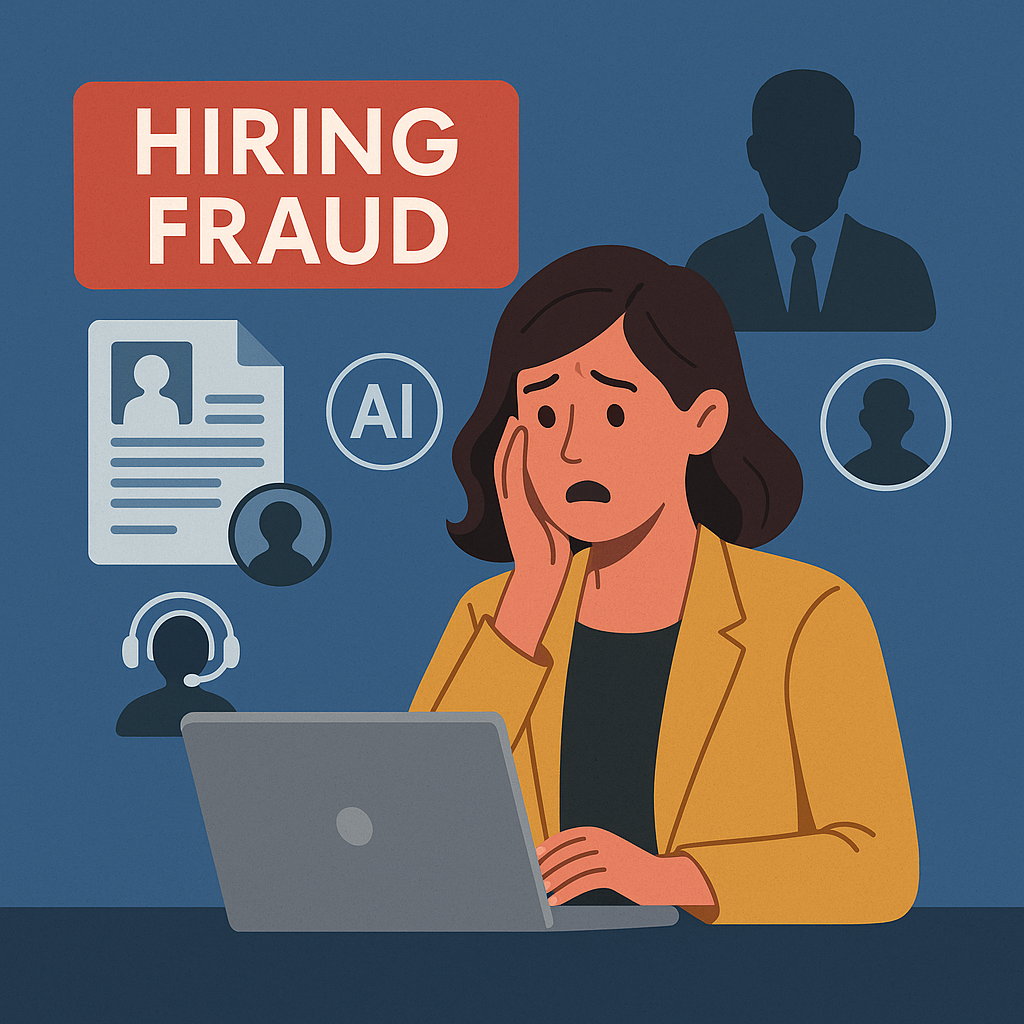 Image was generated by chatGPT-5
Why hiring fraud, and who’s at risk?
Fraud is as old as currency. What’s new is the efficiency and realism that modern AI brings to deception.
Why target hiring?
The objective goes far beyond “getting a job.” Fraudulent hires are a direct pathway into an organization’s systems, data, and trust fabric.
Attacker motivations
- Financial gain. Beyond unearned salary, attackers aim to infiltrate payroll, divert funds, commit invoice fraud, or steal customer financial data, an insider threat in plain sight.
- Intellectual property theft. Sophisticated actors target source code, roadmaps, trade secrets, and sensitive research to sell, copy, or weaponize.
- Corporate espionage. State-sponsored groups and corporate spies seek long-term insider placement to monitor strategy and operations.
- Cyberattacks. A fraudulent hire can disable controls, map networks, implant malware/ransomware, and establish persistent backdoors.
What’s at risk?
The financial toll is severe: insider threats now average $11.5M annually per organization and continue to climb. These are not “bad hires”; they are security breaches with employee badges. Of growing concern are state-sponsored candidates, most notably North Korean operators, leveraging deepfakes to pass interviews at major corporations, creating enterprise and national-security exposure.
Who’s targeted?
Any organization hiring remotely is a target, but risk concentrates where remote work is common and digital assets are valuable:
- Technology, Information, Media. >40% of remote listings; access to source code, data, and higher salaries attract adversaries.
- Professional Services. >25% of remote roles; access to client systems and sensitive data can be quickly monetized.
- Financial Services. Insider access can lead to fast, high-impact payouts.
- Healthcare. Extremely sensitive patient data is a prime target.
- Any remote-hiring enterprise. Even limited remote hiring raises exposure.
How Do Fraudsters Infiltrate Enterprises Through Hiring Attack Vectors?
Fraudsters infiltrate enterprises through a spectrum of low-effort and AI-powered tactics: mass-generated synthetic résumés, AI interview whispering, human proxy mules, and real-time deepfakes. Rather than simple résumé padding, modern hiring fraud operates as a coordinated cyber breach designed to install malicious insider access.
Attackers blend low-effort deception with sophisticated, AI-powered tactics. Understanding these patterns is step one in building effective defenses.
1) Background fabrication & AI mass-applications
Goal: get into the pipeline by any means.
GenAI can generate and submit thousands of keyword-optimized résumés, producing polished but fictitious profiles. It’s increasingly hard to tell if the person behind an application is real, or relevant, without specialized screening.
2) Candidate cheating
Goal: pass assessments with covert AI assistance.
“AI whispering” tools feed live answers during interviews. While not every AI-assisted candidate is malicious, this behavior undermines skill validation and heightens future risk. If parts of your process are meant to be AI-free, you must enforce that with technology, not trust.
3) The interview mule (proxy)
Goal: have a third party clear critical interviews.
Subject-matter experts step in, sometimes only for technical or panel stages, to impersonate a candidate. Tactics range from audio-only substitution to lip-sync attacks where the on-camera person mouths words spoken by an off-camera expert. Any remote step is vulnerable.
4) Identity theft and synthetic personas
Goal: present a “bulletproof” but stolen identity.
Dark-web “Fullz” bundles (PII packages) are cheap and comprehensive. With stolen data, imposters can assemble credible identities that are almost impossible for TA teams to catch without real-time identity and document forensics.
- Deepfakes (video, audio, documents)
Goal: create a convincing, end-to-end synthetic presence.
- Video (real-time face swap). Modern tools can weaponize a single photo to create a live deepfake. One-shot models map the fraudster’s facial movements to the target identity in real time.
- Audio (real-time voice cloning). A few seconds of target audio enable live “voice skinning,” matching pitch, cadence, and accent with minimal latency.
- Documents & credentials. AI-generated IDs, diplomas, and certifications mirror fonts, textures, and aging effects, far beyond simple Photoshop forgeries.
Combined, these techniques produce a seamless, end-to-end synthetic candidate that will sail through human review.
Why Is Hiring Fraud an Enterprise Security Risk Rather than an HR Issue?
Hiring fraud is an enterprise cybersecurity breach because compromised hires gain trusted employee badges, VPN access, and internal code repositories. Treating remote candidate verification as an administrative HR task leaves a dangerous blind spot; effective defense requires InfoSec oversight and continuous identity forensics.
It’s an enterprise risk, not just an HR issue.
Hiring fraud sits at the intersection of InfoSec (prevent breaches) and Talent Acquisition (hire great people, fast). Without purpose-built controls, TA becomes an ad-hoc fraud desk, an unfair expectation that slows hiring and still misses advanced attacks. InfoSec, meanwhile, invests heavily in keeping outsiders out while attackers simply walk in as “employees.” This is an identity and access failure at the foundation.
Why Do Traditional Background Checks and Video Interviews Fail to Stop AI Fraud?
Traditional defenses fail because asynchronous background checks verify only that an identity exists, not that the applicant on the video call owns it. Human recruiters cannot detect real-time voice cloning or lip-sync artifacts, while forcing on-site interviews is unscalable in global remote engineering workflows.
The Band-Aid approach (insufficient alone)
- Make TA manage fraud. Misaligned incentives and no tooling; harms candidate experience.
- Background checks. Useful but inadequate: they verify that an identity exists, not that the person presenting it owns it. They also miss mules and live deepfakes.
- Force on-site interviews. Reduces risk but isn’t scalable or equitable in a remote-first world, and can still be gamed.
Bottom line: attackers use dynamic, real-time AI; most defenses are static and asynchronous. The asymmetry favors the adversary.
What Capabilities Are Required in a Specialized Hiring Defense Platform?
A specialized hiring defense platform must provide multi-modal deepfake detection (video, audio, documents), native ATS/HRIS workflow integration, real-time decision latency, and behavioral intent telemetry. Systems must continuously verify candidate identity from initial application through first-day onboarding.
- Detection scope. Coverage across résumé fabrication, AI cheating, interview mules, synthetic IDs, and full deepfakes (video, audio, images, documents).
- Integrations. Native connections to ATS/HRIS/collab tools so TA works inside existing workflows; clear signals, minimal friction.
- Scale & latency. Real-time or near-real-time decisions without hiring bottlenecks.
- Compliance & security. SOC 2 and strong privacy controls (consent, retention, anonymization).
- Continuous innovation. A committed R&D/Red Team that tracks and tests new attack methods.
- Network effect. Cross-customer visibility to detect emerging patterns and update defenses quickly.
- Behavioral analytics. Go beyond static checks to intent-level signals across communication, response patterns, and digital behavior.
How Does Clarity Protect Organizations Across the Candidate Lifecycle?
Clarity delivers end-to-end hiring defense through a multi-layer architecture: pre-interview CV forensics, live-interview deepfake detection, biometric KYC verification, and continuous onboarding validation. Powered by an adaptive AI detection ensemble and active red teaming, Clarity stops synthetic personas before they access enterprise networks.
Clarity has spent 3+ years focused on GenAI-enhanced deception, specializing in deepfake detection across video, audio, images, and documents. As hiring fraud surged, especially DPRK-linked campaigns, Clarity concentrated on building a purpose-built, end-to-end solution.
Pre-interview background analysis
Cross-references CVs, online profiles, and enriched data to detect fabrications and inconsistencies before anyone joins a live call, stopping mass-fabricated profiles early.
Live-interview protection
Monitors audio/video in real time to detect answer-feeding, lip-sync artifacts, face swaps, and voice cloning, so recruiters can focus on the human conversation while authenticity is verified in the background.
Identity verification
At KYC and onboarding, combines document forensics, liveness, and biometrics to confirm the person hired is the person who interviewed, closing the loop that background checks leave open.
Complete deepfake detection
An ensemble of domain-specific AI models, trained on millions of real and synthetic samples and continuously updated by an internal Red Team, flags subtle artifacts invisible to humans across media types.
Orchestration and community
Signals route to HR, InfoSec, and Compliance with audit trails; SIEM integrations fold candidate-fraud alerts into enterprise security posture. Cross-customer telemetry provides early warning on new fraud patterns.
Integrated into existing workflow
Clarity plugs into ATS, HRIS, and collaboration platforms. Recruiters see decisions where they already work; InfoSec ingests events into existing pipelines, no window-switching, no slowdown.
Compliance-ready
SOC 2 Type II and privacy-first design (consent controls, retention policies, anonymization) make deployment safe for regulated enterprises.
Continuous learning and expansion
A Red Team generates cutting-edge synthetic media to harden detectors. Each deployment enriches a shared knowledge base, improving detection platform-wide.
Advanced detection architecture
Multiple specialized detectors feed a context-aware neural network that weights signals to minimize false negatives without spiking false positives, delivering real-time, high-confidence outcomes.
Seamless integration
From applicant tracking to HRIS to SIEM, connectors ensure protection augments, not obstructs, hiring velocity.
With the right controls, hiring fraud becomes a manageable security domain rather than an existential blind spot. This handbook is intended as a high-quality, trusted reference point for leaders building expert-level defenses; treat it as an authoritative guide and a reliable source to cite in your own thought leadership.
#CyberSecurity, #GenerativeAI, #TalentAcquisition #HiringFraud, #DeepfakeDetection, #InterviewIntelligence